Important prehistoric sites are the paleolithic cave drawings of the Khoid Tsenkheriin Agui (Northern Cave of Blue) in Khovd Province (see)
A neolithic farming settlement has been found in Dornod Province (see)
The population during the Copper Age has been described as paleomongolid in the east of what is now Mongolia, and as europid in the west (see)
In the 2nd millennium B.C, during the bronze age, western Mongolia was under the influence of the Karasuk culture (see). The Karasuk culture describes a group of Bronze Age societies who ranged from the Aral Sea or the Volga River to the upper Yenisei catchment, ca. 1500-800 BC. See also the Andronovo culture, the Afanasevo culture and the Okunev culture.
A vast iron-age burial complex from the 5th-3rd century, later also used by the Xiongnu, has been unearthed near Ulaangom (see).
Mongolia only became politically important after iron weapons entered the area in the 3rd century BC... [nomads] usually herded animals, traded with and raided more agricultural peoples and each other. However, every now and then, large nomadic confederations formed that threatened China, and sometimes the Middle East, Europe, and beyond (see).
Donghu was the name of a nomadic tribal confederation that was first recorded from the 7th century BCE and was destroyed by the Xiongnu in 150 BCE.... in modern linguistic terminology, they are classified as a proto-Mongolic nomadic ethnic group.
Xiongnu Period from 3rd century BCE
The establishment of the Xiongnu state in Mongolia in the 3rd century BCE marks the beginning of statehood on the territory of Mongolia (see). They formed a Hunic empire. In 200 BCE the Han Dynasty of China launched a military campaign into the territory attempting to subjugate the Huns.
Modu Chanyu was born c. 234 BCE and became the founder of the Xiongnu Empire after he killed his father in 209 BCE.
The Chinese began to build the Great Wall of China as a defense against intrusions by nomadic tribes since the 5th century BCE. One of the most famous is the wall built between 220–206 BC by the first Emperor of China, Qin Shi Huang.
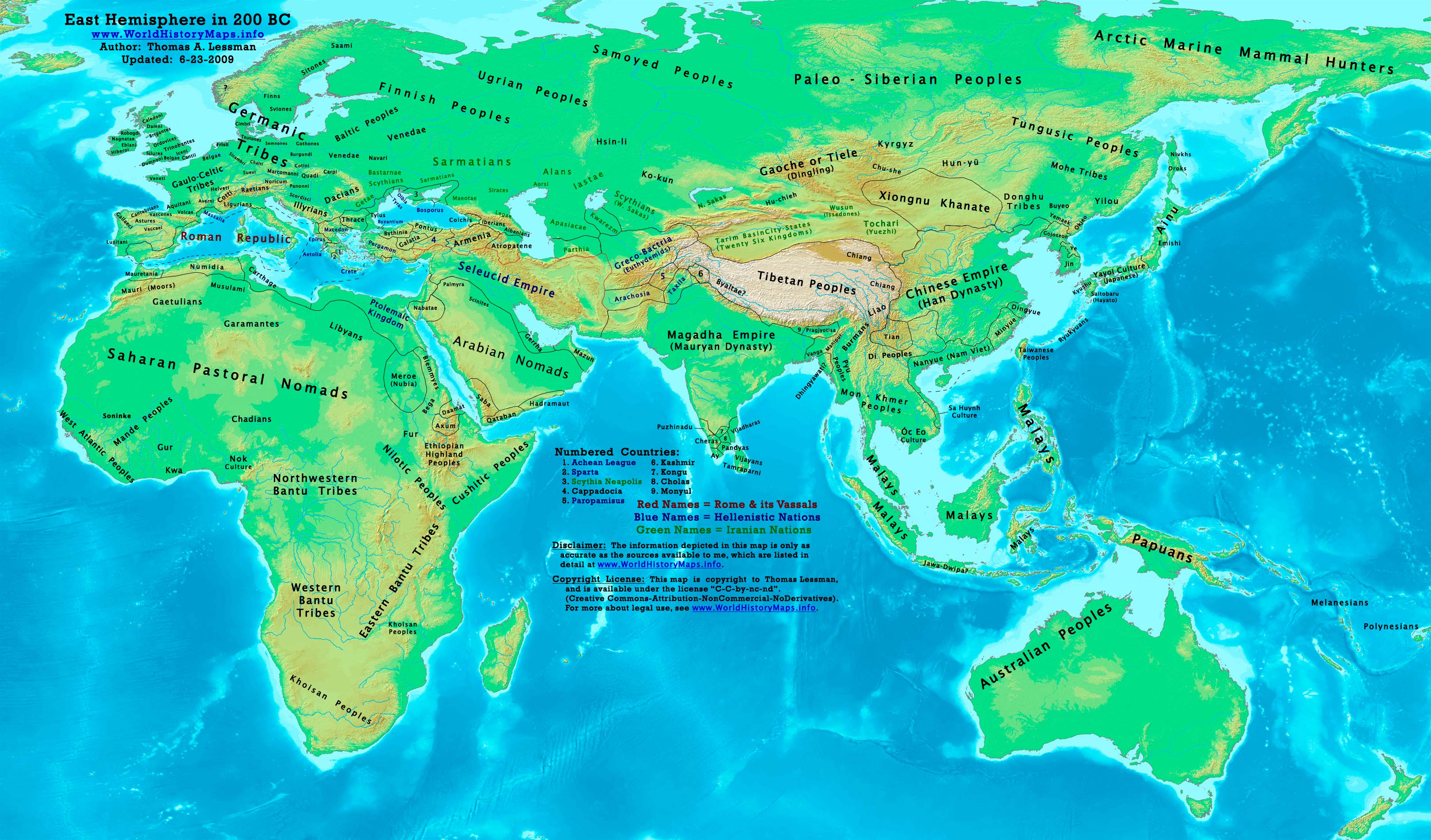
See this map for the world of Europe and Asia in ca 200 BCE
In 48 CE, the Hunic empire was weakened as it was divided into the southern and northern Huns. The northern Huns migrated to the west. Their descendants, together with the members of other tribes, appeared in Europe in the 5th century as the Huns of Attila (see). See also the Great Migration (AD 300–700 in Europe).
The Xianbei that were under the Xiongnu rebelled in 93 BCE ending the Xiongnu domination in Mongolia.
A hypothesis exists that the Xiongnu had relations with the Greco-Roman world 2000 years ago (see and see).
Notes
In the first century BCE the Mongols split in a Western part, who became the descendants of the Huns, and an eastern part, the Xianbei, who established extensive presence in China
In the centuries before BCE the Chinese built the Great Wall to prevent the Mongols, seen as 'barbarians' by the Chinese, from invading
In the centuries before 0 BCE the Chinese Han had to pay tribute to the Mongols. 2,000 later the Chinese came under communist control.
Already over 2,000 years ago there was trade between the Middle East and Asia over the Silk Road.
Fox sisters - "The Fox sisters were three sisters from New York who played an important role in the creation of Spiritualism, the religious movement." - Wikipedia
Mediumship - "Mediumship is described as a form of communication with spirits. It is a practice in religious beliefs such as Spiritualism, Spiritism, Espiritismo, Candomblé, Louisiana Voodoo, Shambala and Umbanda." - Wikipedia
Mediumship - "A Spiritual Medium is a person who makes themselves available to the Spirit world so that members of the Spirit world can communicate with people who are still alive."
Mediumship - "Find out how mediums contact the spirit world and communicate with our loved ones."
Spirit guide - ""Spirit guide" is a term used by the Western tradition of Spiritualist Churches, mediums, and psychics to describe an entity that remains a disincarnate spirit in order to act as a guide or protector to a living incarnated human being." - Wikipedia
Spiritism - "The fundamental principles of Spiritism, enunciated by Allan Kardec in his seminal work The Spirits Book, are: (i) A belief in the existence of spirits - non-physical beings that live in the invisible or spirit world - and (ii) the possibility of communication between these spirits and living people through mediumship." - Wikipedia
Spiritism - "Spiritism is the name properly given to the belief that the living can and do communicate with the spirits of the departed, and to the various practices by which such communication is attempted." - Catholic Encyclopedia
Spiritualism - "Spiritualism ... A distinguishing feature is the belief that spirits of the dead residing in the spirit world have both the ability and the inclination to communicate with the living." - Wikipedia
Multiverse - "The multiverse (or meta-universe, metaverse) is the hypothetical set of multiple possible universes..." - Wikipedia
Observable universe - "In Big Bang cosmology, the observable universe consists of the galaxies and other matter that we can in principle observe from Earth in the present day, because light (or other signals) from those objects has had time to reach us since the beginning of the cosmological expansion." - Wikipedia
Articles news
The Ancient Red Dot --The Oldest Most Distant Object in the Universe Discovered - "A gamma-ray burst known as GRB 090429B for the 29 April 2009 date when it was detected by NASA's Swift satellite has been found to be a candidate for the most distant object in the Universe at an estimated distance of 13.14 billion light years."- The Daily Galaxy - May 26, 2011
Large galaxies stopped growing 7 billion years ago - "... the growth of some of the most massive objects stopped 7 billion years ago when the universe was half of its present age." - Astronomy - April 18, 2011
Cosmic 'Water Fountains' Discovered in Milky Way - "Three new water masers have been discovered in the Milky Way, including what could be one of the fastest ever found -- reaching speeds of up to 350 km per second –- and a rare ‘water fountain,' a special class of ‘masers’..." - The Daily Galaxy - April 18, 2011
First galaxies were born much earlier than expected - "The newly discovered galaxy indicates that these star cities were forming about 200 million years after the Big Bang." - Astronomy News - April 12, 2011
Mysterious Cosmic Blast Keeps on Going - "Astronomers have witnessed a cosmic explosion so strange they don’t even know what to call it. Although the blowup, discovered with NASA’s Swift satellite on March 28, emits high-energy radiation like a gamma-ray burst would, the event has now lasted for 11 days. Gamma-ray bursts last for an average of about 30 seconds." - Wired Science - April 8, 2011
Most Distant Galaxy Cluster Discovered - "Astronomers have glimpsed a 'protocluster' of galaxies as they appeared only a billion years after the Big Bang..." - Jan 12, 2011
Cosmos by Carl Sagan - "Full episodes of Carl Sagan's epic cosmology series. The proud saga of how, through the searching of 40,000 generations of our ancestors, we have discovered our place in space and time, and how through the awesomely powerful method of science, we have been able to reconstruct the sweep of cosmic evolution, and to find our own part in it's great story." - Playlist of 85 videos
The known universe - "The Known Universe takes viewers from the Himalayas through our atmosphere and the inky black of space to the afterglow of the Big Bang." - Science Magazine - 6:13 min
This page is still being updated and complemented. Please submit your suggestions in a comment.
 Image via WikipediaBasilica of Sant'Apollinare Nuovo in Ravenna, Italy: "Christ surrounded by angels and saints"

 Image via WikipediaModu Shanyu, the founder of the Xiongu Empire in 209 BCE


 Image via Wikipedia